

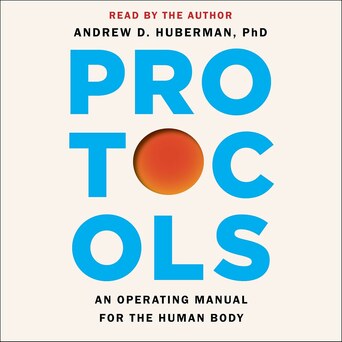
About Protocols: An Operating Manual for the Human Body audiobook
Listen on Audible for free
Try for 30 days, you can cancel whenever you want
Step outside within an hour of waking and look toward the sun. Breathe in twice through the nose, then let it out slowly through the mouth. Lift something heavy a few times a week. The premise of Protocols is that your body already has the controls to run better, and most of them cost nothing. You just have to know which ones to turn and in what order.
That is the pitch Andrew Huberman has been making to millions of podcast listeners for five years, one three-hour episode at a time. Here he finally boils it down. The book is organized around seven areas: sleep, exercise, stress control, nutrition, light, focus and learning, and personal growth. Inside those sit 47 numbered protocols. Each one gives you the steps first, then the mechanism, then the questions people usually ask. If you only want the recipe, you can take the recipe and move on.
It is a big, confident, sometimes overstuffed book. It is also the clearest single statement yet of a way of thinking about health that has quietly changed how a lot of people start their mornings.
Behavior first, molecules second
The strongest idea in Protocols is its ranking system. Huberman puts free behavioral changes ahead of supplements, and supplements ahead of prescription drugs. Morning light, a consistent wake time, a long exhale to calm down fast, short rests between practice repetitions to learn faster. These are the first tools he reaches for, and he explains why each one should work at the level of nerves, hormones and circadian timing.
He is good at the explaining. The science writing is plain and patient, and he rarely hides behind jargon. The reviewer at the Substack Primordial Protocol called it the best manual on the subject he had read and praised the fact that nearly every claim comes with a source. Even readers who roll their eyes at the optimization crowd will find the sleep and stress chapters hard to argue with.
The weaker patches are where the evidence is thin and the language is not. Rebecca Onion, reviewing the book for Slate, pointed to a sleep supplement passage that leans on a single ten-person study of tart cherry juice. She also noted that several recommended products come from companies that sponsor the podcast or in which Huberman has a stake. Those are fair cautions. Read the supplement sections with that in mind and lean on the behavioral protocols, which are the heart of the book anyway.
A fire hose, and how to drink from it
Onion's sharpest complaint is about volume. Add up the daily protocols and you get a routine that could swallow a whole morning. She called it a fire hose that is impossible to drink from, and anyone with insomnia who tries to do everything at once may end up more anxious, not less.
The fix is in how you use the book. Huberman himself says to pick a few protocols and adapt them, and the structure makes that easy. Nobody needs all 47. Most listeners will come away with three or four habits that stick, and that is probably the right result.
Why the audio edition fits this book
Huberman reads the audiobook himself for Simon & Schuster Audio, and that matters more here than for most nonfiction. His audience knows his voice. The measured delivery, the pause to define a term, the way he signals when a claim is solid and when it is only promising, all of it carries over from the podcast. Hearing the steps spoken aloud makes the protocols feel like instructions from a coach rather than a chapter in a textbook.
It is a long listen at around eighteen hours, and a reference book with numbered steps is easier to flip through in print. The sensible approach is to listen through once for the reasoning, then note the handful of protocols you plan to try. For the chapters on sleep, light and stress, which build an argument rather than list items, the audio is the better experience. It also pairs naturally with the one protocol everyone can start tomorrow: a walk in morning sunlight with headphones on.
The professor behind the podcast
Andrew Huberman is an associate professor of neurobiology and ophthalmology at Stanford School of Medicine. He launched the Huberman Lab podcast in 2021, and within two years it was among the most listened-to shows in the world, topping Apple Podcasts and sitting near the top on Spotify in the United States. He has also drawn scrutiny. A 2024 New York magazine profile questioned how active his Stanford lab really is, and scientists have challenged how firmly he states conclusions from early research.
Protocols is his first book. He announced it in mid-2024, saying he had been working on it for more than five years, and it arrived later than first planned. The wait did not hurt it. The book opened at number one on the New York Times list for advice and how-to titles, and the audiobook is high on the Audible charts as well. If you have ever wondered what the fuss is about, the Audible free trial covers it.
This content contains affiliate links. When you buy through these links, we may earn an affiliate commission.
More audiobooks
 Moriarty
 Not Till We Are Lost: Bobiverse, Book 5
 Backfired: Attention Deficit
 The Wonder of Stevie
 The King of the Peso: A Father’s Legacy of Crime and Corruption
 The Let Them Theory: A Life-Changing Tool That Millions of People Can’t Stop Talking About
  Onyx Storm: Empyrean, Book 3
 Gateway: Expeditionary Force, Book 18
  Midnight Black: Gray Man, Book 14
 Garden of Sanctuary: The Wandering Inn, Book 15
 A Parade of Horribles: Dungeon Crawler Carl, Book 8
 Woman Down: A Novel
  System Clash: A LitRPG Adventure (System Universe, Book 8)
  The First Time I Saw Him
 The Primal Hunter 13
  Enough: Your Health, Your Weight, and What It's Like To Be Free
  Unmapped: An Epic Fantasy LitRPG Adventure (The Completionist Chronicles, Book 13)
  The Coffee Shop Detectives
  Hollow Bones
 Dungeon Crawler Carl
 Big Little Truths
 Threshing Day
 Michael
 The Murder at the Vicarage
 The Castle: Adventures in a World of Unravelling Men
 The Poison Daughter