

Podcast ad spend grew 23% in Q2. The money is getting harder for small shows to reach

US podcast advertising grew 23 percent year over year in the second quarter of 2026, according to the quarterly benchmark report from the measurement firm Magellan AI. In a year when several digital ad categories have struggled to post any growth at all, that is a strong number, and it is the one the industry will quote for the next three months.
The detail underneath the headline is more interesting than the headline. The same report shows more brands buying podcast ads than ever, a rising share of every episode given over to advertising, and largely the same companies at the top of the spending table quarter after quarter. On the same day the figures circulated, Audacy told independent podcasters it is closing the free hosting and sponsorship marketplace it had built for them. Our reading is that those two facts belong in the same article: the money is growing at the top of this market while the tools for reaching it at the bottom are being withdrawn.
The confirmed numbers from Q2
Magellan AI analyzed 94,823 podcast episodes for the quarter. Its own summary of the Q2 2026 benchmark report puts year-over-year spend growth at 23 percent and the average ad load — the proportion of an episode’s running time given to advertising — at 8.75 percent, up from 8.25 percent in the first quarter.
Two figures in the report point in opposite directions, and both are worth holding on to. The first is 1,297: the number of brands that advertised on a podcast for the first time during the quarter. That is a wide funnel, and it is the strongest evidence in the report that podcast advertising is still recruiting new buyers rather than recycling the same ones.
The second is that eight of the ten biggest spenders in Q2 were also in the top ten in Q1. RAIN News, reporting on the release, named the retailer Quince as the quarter’s single largest spender at around $19 million.
Insurance was the standout growth category, up roughly 60 percent year over year, with Progressive, State Farm and UnitedHealth Group among the named buyers. Insurance is a reach-and-frequency business rather than a brand-experiment business, and the likely consequence of a category like that moving this much money into audio is more programmatic buying, more run-of-network inventory and more ads that sound identical from show to show.
Which shows the money is reaching
Sports was the second-largest genre by US podcast ad revenue in the quarter, at 13 percent of spend, and 18 percent of the brands new to podcasting put sports shows into their media plans. For a genre that spent years being treated as sports radio’s overflow, that is a meaningful position to have reached.
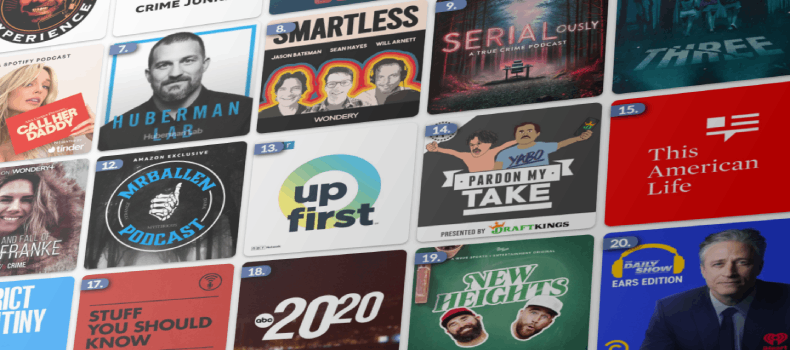
True crime, according to the report, still carries the heaviest advertising load of any genre. If your commute is spent with the true crime podcasts that dominate the charts, you are hearing more ad breaks per hour than almost any other listener, and you have been for some time.
Ad load is the number creators should watch most carefully. An industry-wide move from 8.25 to 8.75 percent sounds trivial; across a 45-minute episode it is roughly another quarter of a minute of advertising, every episode, on top of what was already there. That points to a market delivering part of its growth by selling more inventory rather than by selling the same inventory for more — and inventory growth has a ceiling that listener patience sets, not that sales teams set.
Audacy pulls up the ladder behind it
On 28 August, Audacy confirmed to trade press that it will shut Audacy Creator Lab on 1 November. Creator Lab is the free podcast hosting service and host-read sponsorship marketplace that grew out of Podcorn, the self-serve marketplace Audacy bought for $22.5 million in 2021 and relaunched under the Creator Lab name at Podcast Movement Evolutions in April 2025.
There is no standalone announcement from the company. An Audacy spokesperson told Radio Ink, which first reported the closure: “We’ve made the decision to wind down Creator Lab operations. It’s a very small part of our overall podcasting business where we continue to see and invest in growth.”
The practical terms are narrow. Creators with an open campaign in the Creator Lab Marketplace must complete and submit all deliverables by 1 November. Creators without an active campaign need do nothing. Audacy says it will honor its existing payment terms for eligible earnings on completed campaigns. Podnews counted 426 shows hosted on the platform in the Podcast Index, so the direct disruption is genuinely small in absolute terms, and Audacy’s own description of it as a very small part of the business is fair.
The size of the platform is not what makes the decision worth reporting. What makes it worth reporting is what it removes: one of the last places where a show with a few thousand downloads could be matched to a national brand without an agency, a sales house or a minimum spend. Set that against a quarter in which 1,297 brands tried podcast advertising for the first time, and the awkward question is which shows those newcomers were able to find.
What this means if you make or buy podcast ads
For creators, the two developments combine into a blunt message. There is more advertiser money in podcasting than there was a year ago, and there are fewer self-serve routes to reach it. Our reading is that the sensible response is unglamorous: sit on a host with real programmatic demand connections, keep download reporting clean and measurable, and treat direct relationships with brands in your subject area as something you build rather than something a marketplace supplies.
For buyers, the concentration at the top of the table is an opportunity rather than a problem. If eight of the ten largest spenders repeat quarter after quarter, the shows those advertisers crowd into are being bid up while thousands of mid-sized shows are not. The brands that added sports to their plans this quarter are largely competing over a small set of famous titles, when the actual field of sports podcasts worth advertising on is far deeper than any agency schedule reflects.
What nobody has confirmed yet is whether the newcomer number holds. Adding 1,297 first-time advertisers in a quarter is impressive, but a first-time advertiser is not a returning one, and the report does not say how many of the previous quarter’s newcomers came back for a second flight. Until somebody publishes that retention figure, the growth rate is a measure of trial, not of habit.
Q3 and the autumn selling season
The next benchmark report covers July to September, a quarter containing the start of the NFL season and the approach to the US midterms — two of the largest reasons brands buy audio at all. If ad load keeps climbing through a quarter with that much natural demand, the likely reading is that the market is short of premium inventory rather than short of money, and that publishers are meeting demand by lengthening breaks.
The figure we will be watching in October is not the growth rate. It is whether the distance between the top ten spenders and everybody else narrows. Podcast advertising has spent three years being described as a growth story. On this quarter’s evidence it is also becoming a concentration story, and those two descriptions have very different consequences depending on where your show sits in the chart.
Posted in: All articles